
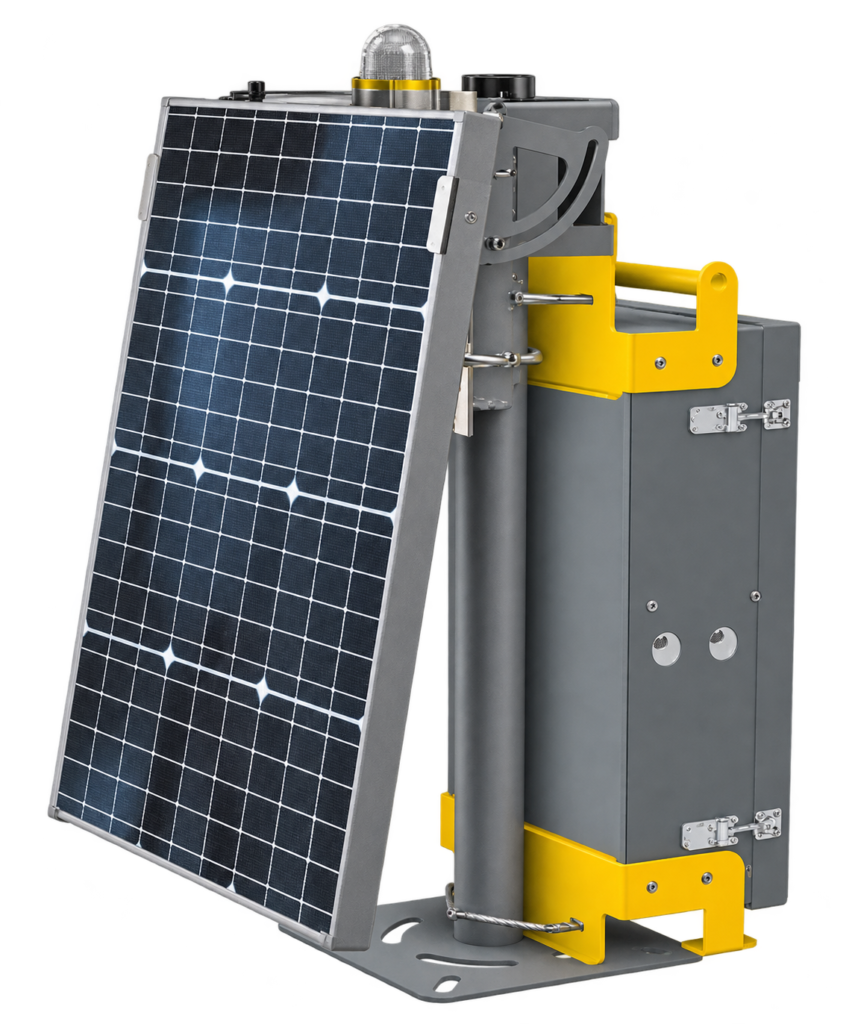
The Arctic Challenge: Aviation Safety Off the Grid
Masts, towers, chimneys and wind turbines must carry obstruction lights so pilots can see them. In the far north, many of these structures stand where there is no power line, and some are hours from the nearest road.
For operators, the light is only part of the cost. The bigger cost is keeping it working, driving out to check it, finding out too late that it has failed, and travelling again to fix it
“Years ago, our clients came to us with this problem. There was simply no obstruction light on the market that could get through an entire Arctic winter,” says Vesa Laakso, CTO of Obelux. “And when it comes to aviation safety, an obstruction light has to work, every single day.”
Built for extremely harsh weather
After months of development in our in-house laboratory, our team of engineers, technicians and electricians created the LI-SP NORDIC: a complete solar-powered, low-intensity obstruction light solution, built for areas with little sunlight and a cold climate.
Most people assume solar power only works where the sun shines constantly. In fact, solar panels also generate electricity from indirect daylight too, although much less under cloudy weather and deep winter, but they keep producing. The real question in the Nordic countries isn’t whether solar panels work, but whether a system can generate and store enough energy to get through the longest periods without sun.
This is what the LI-SP NORDIC was designed for. To collect and store enough energy to get through the darkest weeks of the year.
Not just a light: a complete system
The LI-SP NORDIC is a complete off-grid solution. Four parts work together:
- The obstruction light, which switches itself on at dusk and off at dawn and checks itself for faults.
- A 60 W solar panel, with a smart MPPT charge controller that captures as much energy as possible from every hour of daylight.
- A battery bank, sized to your site, that stores enough energy to get through the darkest months.
- Remote monitoring. An optional 4G/LTE modem sends status data and SMS alerts. An alarm relay and a Modbus (RS-485) connection to an Obelux aviation light system are also available.
With these, you know the status of your lights without travelling to the site, and you learn about a fault as soon as it happens.
Plenty of stored energy: The battery bank uses sealed 12 V lead-acid batteries (VRLA). Standard setups hold up to 340 Ah, and a third battery raises this to 510 Ah, about as much energy as seven or eight car batteries.
Up to four months without sun: With the largest battery bank fully charged, a 32 cd light can stay on around the clock for up to four months with no solar charging. This figure is rated at −35 °C. Batteries hold less energy in deep cold, so the colder the site, the shorter the run time. In normal use the light switches off during the day, so it lasts even longer.
Works in extreme temperatures: The system operates from −40 °C to +60 °C.
Adapted to your site: The light is available as a 10 cd light for ICAO Type A marking or a 32 cd light for ICAO Type B (steady) or Type E (flashing) marking, all in aviation red. An optional infrared light (850 nm) makes the structure visible to pilots using night-vision goggles. Optional GPS synchronization makes flashing lights blink together, so pilots see them as one obstacle.
Flexible and tough: The light, solar panel and battery bank can each be placed where they work best, and the light also works with solar panels and batteries from other suppliers. The body is anodized, marine-grade aluminium with stainless steel parts, and the polycarbonate cover is rated IP66 (IP67 optional).
Meets the regulations: The light complies with ICAO Annex 14 (low-intensity Type A, B and E), FAA L-810, and national requirements in Finland, Sweden, Norway and the Netherlands.
Proven in the Arctic Circle
In autumn 2023, the system was installed north of the Arctic Circle in a test project with the Swedish company CHS Controls. It was a demanding test. In most countries, obstruction lights only need to be on from dusk to dawn. Sweden is an exception as in Sweden, the lights must stay on 24 hours a day, which uses far more power, but the LI-SP NORDIC’s solar panel system could still handle it. Through the polar night and temperatures as low as −40 °C, the light shone steadily without any external power supply. The battery never dropped below 40% of its capacity.
Today, the LI-SP NORDIC has been running for three years in Kiruna, northern Sweden.
Beyond the Arctic: A Solution for Remote Infrastructure
The LI-SP NORDIC is especially valuable for:
- Wind farm owners, with turbines spread over large areas and often far from service bases
- Tower and telecom companies, managing masts across whole regions
- Utilities, marking power line masts and other infrastructure in remote terrain
Need an obstruction light where there’s no power? Contact our sales team at info@obelux.com or send us your request through our contact form: https://obelux.com/contact-us/